How Ammunition Pro Llc can Save You Time, Stress, and Money.
Fascination About Ammunition Pro Llc
Table of ContentsSee This Report about Ammunition Pro Llc8 Easy Facts About Ammunition Pro Llc ShownThe Main Principles Of Ammunition Pro Llc The Best Guide To Ammunition Pro LlcAmmunition Pro Llc Fundamentals Explained
The standard components of ammunition are the exact same for rifle, pistol, and shotgun ammunition. Today we're looking at the what the fundamental parts of ammunition are and exactly how they function with each other to fire a round.It houses the primer and powder. The bullet is seated in the open end of the situation. When you terminate a bullet out of a semi-auto gun, the gun's extractor raises the situation from the firing chamber and it flies out of the weapon. The situation is likewise often described as coverings, brass, or cases.
A weapon's firing pin strikes a cartridge's guide. The primer is a steel mug that holds an eruptive chemical substance. When the firing pin strikes the primer cap, it crushes the priming substance versus the anvil. This produces a little explosion in the case that fires up the propellant. The primer is located in the rim of the instance of a rimfire cartridge.
Excitement About Ammunition Pro Llc
Gunpowder following to the case that commonly has it. It is usually a mixture of saltpeter, charcoal, and sulfur.
We call the projectiles for shotshells, which we fire via shotguns, slugs and shot. A slug is one solid piece, normally constructed of lead. Shot is a group of pellets made out of lead, steel, bismuth, or tungsten alloy. Shot pellets can come in different dimensions and amounts. Since you have a fundamental understanding of the basic parts of ammo, you can really feel a little a lot more certain in how your gun and ammo feature!.
Ammunition Pro Llc Things To Know Before You Get This
Stay on top of Special Deals, Advancement Notice of Sales, and Store Events
Enjoyable truth: Grains are made use of to describe the mass of a bullet due to the fact that right back in the early days of firearms, it was a dispenser's device of measurement, and an usual measure was needed to determine how much lead to use to make actors lead bullets (Shooting Supplies). 'Grains' as a system of procedure for weight goes all the means back to ancient times, and represents the weight of a grain of wheat

(https://public.tableau.com/app/profile/ammunition.pro/vizzes)For reference, the weight of a paper clip is around 16 gr. We recognize that grains are an action of mass, and more = heavier, and heavy is excellent? Yes, hefty is great, however mass of the projectile isn't the only point you require to consider when selecting a round for your firearm.
Some Known Questions About Ammunition Pro Llc.
This spin is developed by grooves cut or hammered into the interior of the barrel, which are referred to as 'gunning'. Fun truth, this is the origin of the term "Rifle" ex-spouse. A rifled musket vs. smoothbore musket. The impact this spin carries projectiles is a maintaining one the bullet turning maintains the nose pointed directly, similarly that a flawlessly spiraled football throw is mosting likely to be a lot a lot more secure and accurate in trip than an ugly duck, end over end toss.
Just how does this relate to grain weight? Imagine you're on one of those play area carousels, the ones with bars you hold on to while it rotates.
The very same result happens with bullets. The heavier the projectile, the more effect a much faster spin will have on it.
Get This Report about Ammunition Pro Llc
But there's one more aspect that we need to consider when choosing a grain weight for our ammo. As hinted at above, bullet velocity, or the rate of the projectile, is a significant element when determining the very best grain weight projectile to use. Rate is influenced by a few major elements, including the kind and amount of propellant (gunpowder), barrel length, and bullet weight.
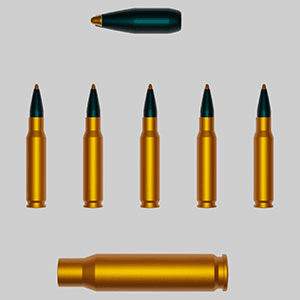
One of the most typical grain weight rounds for 9x19mm cartridges are 115gr and 124gr. These are normally lead core, totally jacketed (FMJ) rounds. Both of these grain weight cartridges will do well in factory 9mm pistols, to normal pistol distances (up to 50 lawns). 115 grain rounds are the most common (and as a result least expensive).